A Brass Shower Head can look simple on a showroom wall, yet its performance depends on details hidden inside the fixture. Brass composition, casting quality, machining, cartridge fit, and finish all affect durability and everyday use. A polished surface may catch the eye, but it cannot prove what lies beneath. Small details matter.
Design researcher Don Norman wrote, “Good design is actually a lot harder to notice than poor design, in part because good designs fit our needs so well that the design is invisible.” His observation addresses design broadly, not brass shower fittings specifically, but it offers a useful lens: a shower head should feel intuitive, deliver a steady spray, and remain easy to clean. That standard is practical, not glamorous.
This guide to China Top 10 Brass Shower Head Manufacturers is intended as a starting point for buyers comparing suppliers. It considers product range, manufacturing capabilities, quality-control practices, customization, and communication. These factors deserve direct verification. Request material specifications, finish samples, test records, and clear answers about production capacity. Ask how the supplier checks water flow and surface consistency. A catalog alone is not enough.
Rankings can simplify a crowded market, but they cannot replace factory audits or sample testing. Supplier information changes, and public claims may be incomplete. That is worth remembering. A promising quotation may still leave unanswered questions about tolerances, replacement parts, or packaging. Use this list to identify candidates, then compare evidence carefully. The right partner is not always the one with the lowest price or the most impressive showroom.
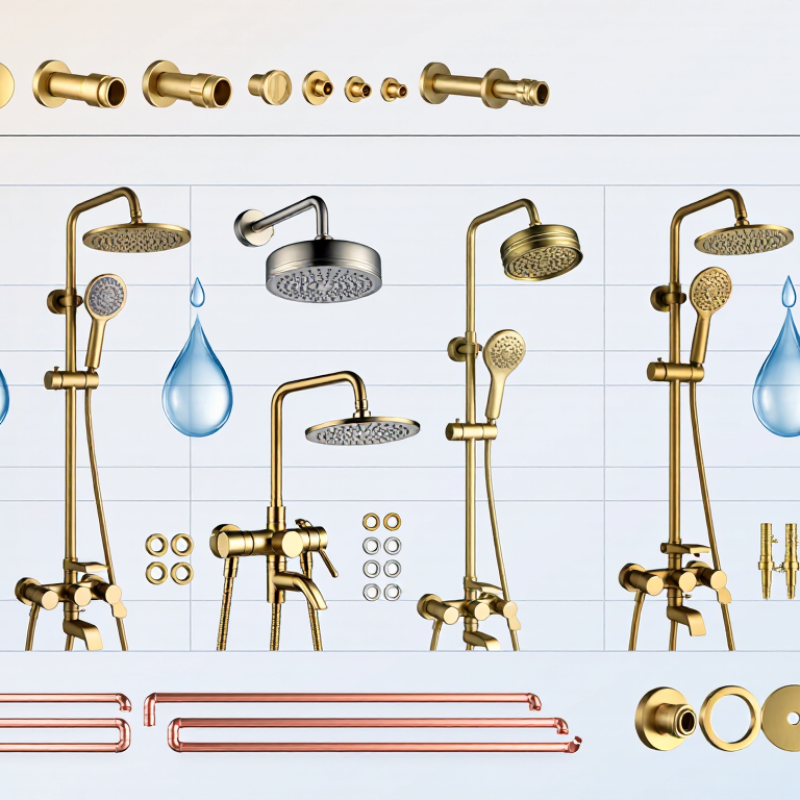
China’s brass shower head sector draws on a deep metalworking base, with production spanning brass casting, precision machining, polishing, surface treatment, and final assembly.
The China Nonferrous Metals Industry Association reported 12.99 million tonnes of refined copper output in 2023. This figure describes upstream copper supply, not showerhead production, but it helps explain the scale of available material-processing capacity.
Brass also requires zinc, and manufacturers must manage alloy consistency to reduce porosity, uneven color, and leaks.
Factory capability varies. Some suppliers handle casting and machining in-house, while others rely on specialist workshops for plating or finishing. Buyers should examine material specifications, wall thickness, thread accuracy, flow testing, and coating adhesion—not just polished appearance.
Small details matter. A clean-looking sample can still conceal inconsistent internal passages. This sounds tidy on paper; factory practice is less tidy.
The UN Comtrade database offers useful trade data, but broad product classifications may combine several plumbing fittings. They cannot always isolate brass shower heads, so export totals should be interpreted cautiously. Audits, repeat-sample testing, and clear inspection records provide a more practical view of production reliability.
Brass shower heads begin with alloy selection, because the metal must handle heat, water pressure, and repeated use. Manufacturers commonly use brass for the main body, while the spray plate may be brass or another compatible material. Alloy composition affects machinability, corrosion resistance, and the finished surface. Buyers should ask for material documentation rather than judging quality by weight alone.
Production often starts with casting or forging, followed by machining of the inlet, internal passages, and threaded connections. Each opening needs careful finishing; rough edges can restrict flow or trap debris. Small details matter. Polishing prepares the surface for plating or another protective finish, but appearance is not a reliable measure of internal quality. A polished surface can hide a weak passage.
Quality checks should include dimensional inspection, pressure testing, and examination of the finish. Spray nozzles also need consistent alignment, so water reaches the user evenly instead of forming stray jets. In practical sourcing, it is worth asking how samples are tested and whether checks are repeated during production. Some factories emphasize surface shine more than water-flow consistency; that trade-off deserves a closer look. Water quality and maintenance can also affect finish life, so no coating should be treated as permanent.
China’s brass shower head manufacturers should be compared through verifiable production evidence, not catalog photos alone. Ask whether the body uses brass throughout, and request material specifications for the head, connector, and internal parts. Confirm machining tolerances, thread standards, and the finishing process. A smooth surface matters, but so does consistent coating around edges and spray openings. Request actual test records. They should state conditions for leak checks, water pressure, and finish durability.
Factory capability is another useful measure. Review inspection points, equipment, and how rejected parts are corrected. Clarify minimum order quantities, tooling charges, lead times, and approval procedures for drawing changes. Ask for a production sample, then inspect its weight, thread fit, spray pattern, and resistance to hand tightening. Check final inspection plans and packaging that protects polished surfaces from scratches. That distinction matters. A sample cannot prove every batch will match, and no checklist predicts every installation. Follow up on vague answers about alloy grades or test pressure, and assess whether the supplier explains limitations clearly.
China’s brass shower-head sector includes factories with very different strengths. These ten profiles focus on capabilities buyers can verify, rather than unsupported rankings. One integrated producer casts brass bodies and machines them in-house, while a precision workshop specializes in threaded connections and smooth, clean edges. A third offers flexible OEM runs for smaller orders; another focuses on export packaging and inspection records. Details matter.
The remaining profiles cover varied production models: a maker of hand showers with reinforced hoses; a plant offering multiple spray patterns; a supplier with in-house polishing and plating; a workshop focused on water-saving designs; a factory combining brass components with polymer nozzles; and a specialist serving custom dimensions. Compare alloy documentation, finish consistency, leak-test procedures, and replacement-part access.
The U.S. EPA WaterSense showerhead specification sets a maximum flow rate of 2.0 gallons per minute (7.6 liters per minute), a useful benchmark for evaluating flow claims, though not a universal purchasing requirement.
Ask suppliers for test conditions and measured results. A catalog can look convincing; a clear test record is more useful. One limitation remains: polished samples may not reflect batch-to-batch finish variation, so request production-lot checks before approval.
When comparing China’s top brass shower head manufacturers, treat certifications as evidence, not decoration. Ask for current test reports tied to the exact model and material. A certificate for one finish may not cover another. Confirm that brass composition, surface coating, water-contact safety, and flow performance meet requirements in your target market. Paperwork matters. So does traceability: batch records and inspection dates help buyers investigate defects later.
Applications shape the specification. A compact home bathroom may need a simple fixed head, while hotels often prioritize durable finishes and easy replacement. For hard-water regions, ask how nozzles resist scale and how cleaning affects the coating. Request a production sample, then check its weight, thread fit, spray consistency, and finish under bright light. A polished sample can still hide uneven plating. I have seen buyers focus on price and overlook spare-part availability; that is an easy mistake to make. Compare minimum order quantities, tooling charges, lead times, packaging, and responses to quality complaints. Ask how defects are recorded and corrected. A clear answer is useful; a perfect promise is not. For a fair supplier comparison, document the same tests and commercial terms for every candidate.
Supplier evaluation checklist: compare documented capabilities and product-specific evidence rather than assuming that every manufacturer holds every certification. Requirements depend on the destination market and product configuration.
| No. | Evaluation factor | Evidence or applicable benchmark | Applications and why it matters |
|---|---|---|---|
| 1 | Brass material traceability | Request material specifications, batch traceability, and test reports identifying the brass alloy and relevant restricted substances. Confirm the requirements for the destination market. | Important for residential and commercial products where corrosion resistance, material consistency, and compliance documentation are required. |
| 2 | Drinking-water contact requirements | For applicable products and markets, check relevant requirements such as China’s GB/T 17219-2021 for safety evaluation of equipment and protective materials in drinking-water systems, or NSF/ANSI/CAN 61 for health effects of components in contact with drinking water. Verify product and scope coverage. | Relevant when a shower fitting falls within the destination market’s drinking-water product rules; applicability should be confirmed with the regulator or certification body. |
| 3 | Plumbing product standard | For North American projects, check whether the specific fitting is tested or certified to ASME A112.18.1/CSA B125.1 and whether the listing covers the offered model. | Useful for projects specifying plumbing supply fittings in the United States or Canada; verify the local code and project requirements. |
| 4 | Water-flow performance | Request flow-rate test data at stated pressure conditions. In the United States, EPA WaterSense-labeled showerheads meet the program’s maximum flow rate of 2.0 gallons per minute (7.6 liters per minute) and other applicable criteria. | Relevant to water-efficiency targets in homes, hotels, and commercial buildings. Compare performance at the operating pressures expected on site. |
| 5 | Pressure and leakage testing | Ask for documented pressure, leakage, and functional test procedures, including test conditions, sampling frequency, and acceptance criteria. | Supports reliable operation in residential bathrooms, hotel installations, and other projects where leaks can cause costly maintenance or water damage. |
| 6 | Corrosion and finish durability | Review finish specifications, adhesion and corrosion test reports, cleaning instructions, and any warranty terms. Check that reports apply to the actual finish and model. | Especially important for coastal properties, high-use hospitality bathrooms, and products exposed to frequent cleaning or hard-water deposits. |
| 7 | Quality-management system | Check the certificate issuer, validity dates, certified site, and scope of any ISO 9001 quality-management certification. ISO 9001 is a management-system standard, not proof that an individual showerhead is certified. | Helps assess production controls and consistency for repeat orders, private-label programs, and multi-site construction projects. |
| 8 | Production and inspection capacity | Confirm monthly capacity, lead-time assumptions, in-process checks, final inspection records, and how nonconforming products are handled. Validate capacity against a sample order or audit where appropriate. | Useful for matching supply plans to renovation schedules, hotel fit-outs, distributor replenishment, and large-volume building projects. |
| 9 | Customization and compatibility | Specify connection dimensions, thread requirements, spray pattern, finish, packaging, and any requested custom tooling. Obtain drawings and a pre-production sample for approval. | Matters for replacement installations, coordinated bathroom collections, distributor assortments, and projects with defined design or packaging specifications. |
| 10 | Documentation and after-sales support | Assess availability of current test reports, installation instructions, spare-parts lists, warranty terms, complaint handling, and a clear process for verifying certificates and model numbers. | Supports distributors, contractors, facility managers, and importers that need installation guidance, maintenance parts, and traceable compliance records. |
Note: Certification and regulatory requirements vary by jurisdiction, product design, and intended use. Confirm current requirements and certificate scope before placing an order.